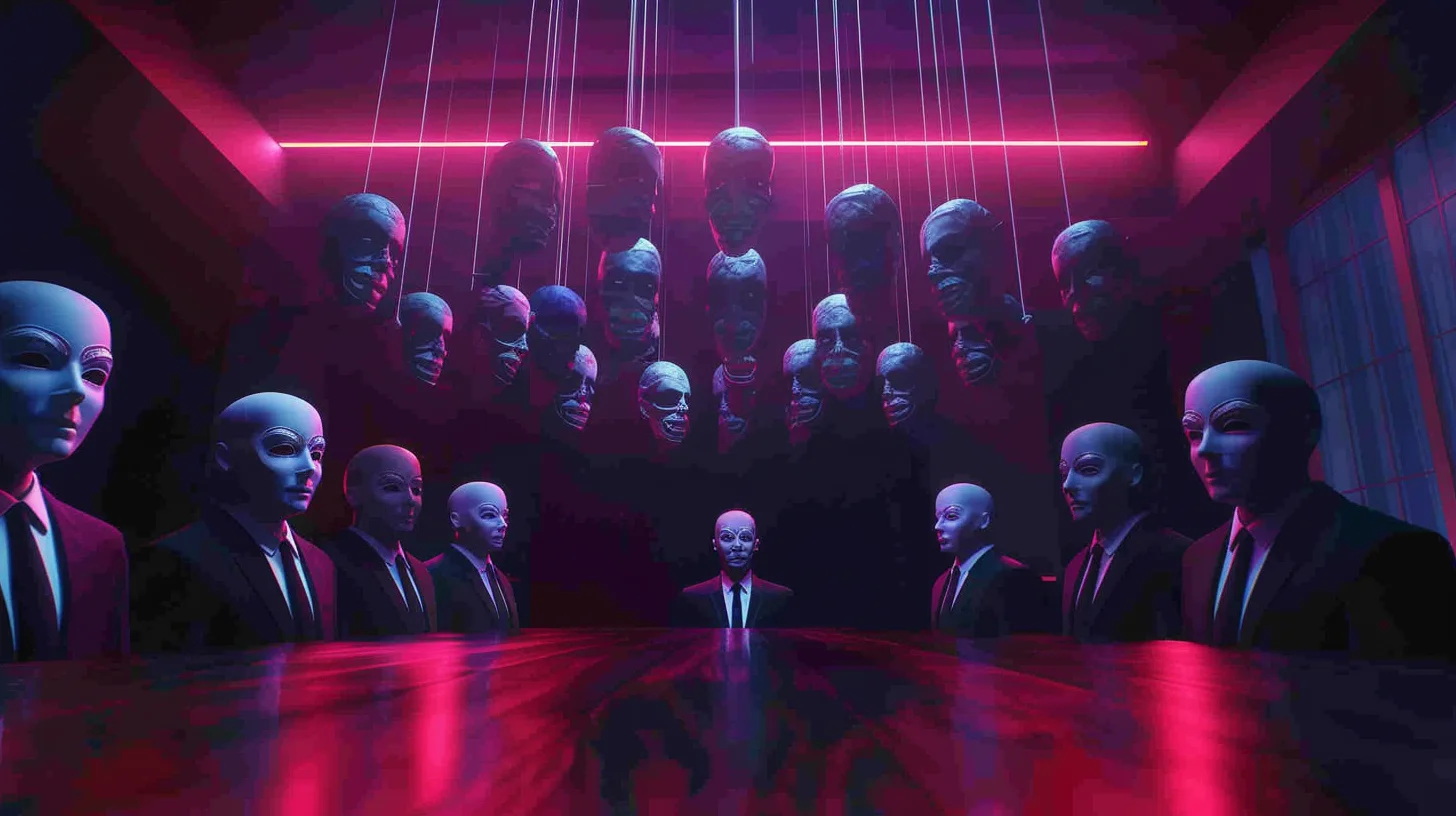
Key takeaways
- When fear masks itself as gratitude.
- If you applaud loudly enough, nobody asks what you really think.
- When fear masks itself as gratitude.
The Standing Ovation
The all-hands is packed. Every seat taken, every camera on. The CEO strides to the front of the room, slides clicking behind them - new strategy, new vision, new era. The language is soaring. Words like "transformational" and "together" and "our incredible team" float through the air like confetti.
And when the CEO finishes, the room erupts. Applause. Real, loud applause. People are nodding. People are smiling. Someone in the front row is already composing the LinkedIn post: "Proud to be part of this incredible team! Exciting times ahead! #blessed #grateful #oneteam"
The team photo gets posted. Thirty-seven likes in the first hour. Comments from colleagues: "So inspiring!" "This is why I love working here!" "The future is bright!" It looks like a company at the top of its game - unified, energized, all rowing in the same direction.
But then the meeting ends. The cameras turn off. The Slack DMs light up. And the real conversation begins.
"Did you understand any of that? What are we actually doing differently?" "More of the same repackaged as transformation." "I'm updating my resume tonight." "I'll give it three more months. If the reorg doesn't fix things, I'm out." "Did you notice how nobody asked a single hard question?"
Two realities exist simultaneously: the public performance and the private truth. The LinkedIn post and the group chat. The standing ovation and the exit plan. The loyalty is skin-deep. The performance is Oscar-worthy.
This is theatrical loyalty - the organizational phenomenon where people don't stay because they believe in where the company is going, but because leaving looks bad, because they've mastered the art of performing dedication they don't feel, because the social cost of honesty has become higher than the personal cost of pretending.
And here's what makes it truly dangerous: from the outside, it looks exactly like the real thing. High attendance at company events. Enthusiastic survey responses. Long tenures. Low voluntary turnover. Every metric says "healthy." Every signal says "engaged." But underneath the performance, the organization is hollowing out - one silent disengagement at a time.
How It Takes Root
Theatrical loyalty doesn't appear overnight. Nobody wakes up one morning and decides to fake their commitment to an organization. It grows slowly, like mold behind wallpaper - invisible to anyone who isn't looking closely, but slowly rotting the structure from the inside.
It starts with something small. Maybe an honest question in a meeting that gets deflected. Maybe a piece of critical feedback that earns the giver a reputation as "not a team player." Maybe a reorganization that contradicts everything leadership said last quarter, delivered with the same enthusiasm as the original plan, and nobody acknowledges the contradiction. You notice. You file it away. You learn.
What you learn is this: honesty is expensive and performance is free. Speaking your mind carries risk. Nodding along carries none. And so the rational actor - and most people in organizations are rational actors - makes the rational choice. They perform.
The performance calcifies through five distinct mechanisms, each reinforcing the others until theatrical loyalty becomes the default mode of organizational life.
In most organizations, disagreeing publicly is a career risk. Not because there's a policy against it - rarely is there anything so explicit. It's subtler than that. The person who questions the CEO's strategy in an all-hands doesn't get fired. They get labeled. "Negative." "Not aligned." "Difficult." They get passed over for the next project lead role. Their name comes up in talent reviews with a caveat: "Smart, but..." And everyone watches. Everyone learns the lesson: it's easier to nod and leave quietly than to speak up and be marked. The social cost of dissent creates a market where silence is cheap and honesty is expensive. Rational people respond to incentives. The incentive structure here is crystal clear.
In organizations that punish skeptics - even informally, even gently - performing loyalty becomes rational self-preservation. This isn't cowardice. It's adaptation. When the environment selects for compliance, compliance is what you get. People learn to read the room. They learn which opinions are safe and which are career-limiting. They develop a sixth sense for when the boss wants agreement versus when they actually want input (spoiler: it's almost always the former). The most talented performers don't even experience it as performing anymore. They've internalized the script so thoroughly that the mask has fused with the face. They genuinely believe they're being authentic - even as they carefully curate every public statement for maximum safety.
Leaving is framed as betrayal. "Not being a team player." "Not being committed enough." "Abandoning the mission." The language around departure is loaded with moral weight, as if staying were virtuous and leaving were a character defect. This creates the golden cage effect: people stay not because the cage is comfortable, but because they've been told that wanting to leave means something is wrong with them. The exit stigma has a secondary effect: it makes departures shocking. When someone who has been performing loyalty for years finally leaves, leadership is genuinely stunned. "But they seemed so engaged!" Yes. That was the point. That was the performance. You were the audience, and you believed every word.
Leadership starts measuring the wrong things. Tenure becomes a proxy for health. Survey scores become a proxy for engagement. Attendance at optional events becomes a proxy for commitment. None of these measure what they think they measure. Long tenure in a theatrical-loyalty culture doesn't mean people love working there - it means they're risk-averse or trapped. High survey scores don't mean people are engaged - they mean people know the surveys aren't anonymous (or don't trust that they are). Perfect attendance at company offsites doesn't mean people are committed - it means absence gets noticed. When loyalty metrics replace strategy metrics, leadership operates on a fiction. They believe they have an engaged, committed workforce. What they actually have is an audience that has learned its lines.
Every organization has rituals. Healthy ones create genuine connection - shared meals, collaborative problem-solving, celebrations of real achievements. Theatrical-loyalty cultures have a different kind: mandatory fun. Team-building that's really loyalty-building. Company events where the implicit contract is "attend and perform enthusiasm, or be noted for your absence." These rituals serve a purpose, just not the one on the agenda. They're loyalty tests disguised as celebrations. Each event is an opportunity to demonstrate that you belong, that you're on the team, that you believe. The pizza party after a brutal quarter. The "optional" happy hour that everyone knows isn't optional. The hackathon where the winning project is always the one that aligns with leadership's existing priorities. The ritual isn't about building culture. It's about enforcing performance.
The Quiet Erosion
The symptoms of theatrical loyalty are paradoxical: everything looks fine on the surface. That's the whole point - the performance is designed to look like health. But underneath the metrics and the LinkedIn posts and the standing ovations, the organization is eroding in ways that don't show up on any dashboard.
The first symptom is high tenure paired with low innovation. People stay for years - five, ten, fifteen - but they stop contributing anything beyond the minimum requirements. They hit their KPIs. They attend the meetings. They fill out the surveys. But they never propose anything new, never challenge anything old, never volunteer for anything risky. They've become organizational furniture: always present, perfectly positioned, contributing nothing to the conversation.
This is quiet quitting in its purest form - not laziness, not disengagement, but a rational withdrawal of discretionary effort from a system that rewards performance over substance.
The second symptom is the yes-people problem. Leadership is surrounded by agreement. Every idea gets affirmed. Every strategy gets endorsed. Every decision gets supported - at least in the room. The CEO presents a plan and hears nothing but enthusiasm. The VP proposes a direction and nobody raises concerns. It feels like alignment. It looks like consensus. It's neither.
What it actually is: a room full of people who have learned that agreement is safe and disagreement is dangerous. The silence isn't agreement - it's strategic. Nobody is actually weighing the merits of the proposal. They're weighing the social cost of objecting. And since that cost is always higher than the cost of nodding, they nod.
The third symptom is shock at departure. In theatrical-loyalty cultures, leadership is always blindsided when someone leaves. "But they seemed so happy!" "They just got a great review!" "They never raised any concerns!" Of course they didn't. They were performing. And leadership was watching the performance, not the person.
Here's the part that stings: the departing person often tried to signal their dissatisfaction. They mentioned it in a 1:1 and got redirected. They raised it in a survey and watched nothing change. They hinted at it in conversation and were told to "focus on the positive." Each failed signal taught them the same lesson: this organization doesn't want to hear what I actually think. It wants me to perform. So they performed - right up until the day they submitted their resignation.
The fourth symptom is the innovation drought. Theatrical-loyalty cultures produce a specific kind of stagnation. Not the dramatic kind - no mass layoffs, no failed products, no visible crisis. Just a slow, grinding deceleration. Products iterate but never leap. Processes solidify into rituals. "The way we do things" becomes sacred, not because it works, but because questioning it would be an act of disloyalty.
Innovation requires dissent. It requires someone saying "this isn't working" or "what if we tried something completely different?" In a culture where those statements carry social risk, innovation doesn't die - it simply never gets born. The ideas exist. They're in people's heads, in their private notes, in their conversations with trusted friends outside the company. But they never make it into the room where decisions are made, because the room where decisions are made is also the room where loyalty is performed.
The fifth and most insidious symptom is the erosion of trust. When everyone is performing, nobody trusts the performance. People become suspicious of enthusiasm - is this person genuinely excited, or are they positioning? They become skeptical of praise - is this feedback real, or is it theatre? They start second-guessing every interaction, looking for the script behind the spontaneity. The paradox is devastating: a culture designed to produce visible loyalty actually destroys the foundation of real loyalty, which is trust. When you can't tell what's real and what's performance, you stop believing in any of it.
The Mirror Test
How do you know if your organization has a theatrical loyalty problem? You can't trust the obvious metrics - that's the entire point of the performance. Instead, you need to look at the gaps, the silences, the things that should be happening but aren't.
When was the last time someone publicly disagreed with a senior leader?
If you can't remember, that's not because everyone agrees. It's because disagreement has been priced out of the market.
Do your departures surprise you?
If people leave and leadership is always shocked, it means the feedback channels are broken. People are performing contentment right up until the exit interview - if they're even honest there.
Are your longest-tenured employees your most innovative?
In a healthy culture, experience breeds confidence, and confidence breeds creative risk-taking. In a theatrical culture, experience breeds better performance. Long tenure plus low initiative is a flashing red light.
Do your surveys produce actionable criticism?
If every survey comes back overwhelmingly positive, either you've achieved organizational nirvana or people don't believe the results are truly anonymous. Bet on the second one.
What happens after the all-hands?
Listen to the hallway conversation, the DMs, the coffee-corner chatter. If the energy there is dramatically different from the energy in the room, you have a theatrical loyalty problem. The all-hands was act one. The hallway is the real show.
The hardest part of diagnosing theatrical loyalty is that the patient presents as perfectly healthy. Every vital sign is normal. Every test comes back clean. But the patient is dying - slowly, quietly, behind a mask of perfect health.
The Antidote
Fixing theatrical loyalty requires more than a "we value honesty" poster in the break room. It requires systematically changing the incentive structure that makes performance rational and honesty risky. This is hard work. It's uncomfortable work. And it starts at the top.
Make disagreement safe before measuring agreement. This is the foundational principle. If you measure engagement before creating psychological safety, you're not measuring engagement - you're measuring performance quality. Before you send that next employee survey, ask yourself: have we created conditions where a truly honest answer won't carry consequences? If not, you're just commissioning a work of fiction.
Practically, this means leaders going first. Not saying "my door is always open" - that's its own form of theatre. Actually disagreeing with each other in public. Actually saying "I was wrong about that." Actually responding to criticism with curiosity instead of defense. When the C-suite models vulnerability, the rest of the organization slowly starts to believe it's safe. When the C-suite models perfection, the rest of the organization performs it.
Test loyalty by inviting criticism. If nobody criticizes, nobody's actually engaged. They're just performing for an audience that has forgotten it's watching a show.
Track contribution, not tenure. Stop celebrating how long people have stayed. Start celebrating what they've changed while they've been here. A five-year employee who hasn't proposed a new idea in three years isn't loyal - they're retired in place. A two-year employee who constantly challenges assumptions and pushes boundaries is giving you something far more valuable than tenure: they're giving you their actual thinking.
Redesign your talent reviews around this principle. Instead of asking "who are our most loyal people?" ask "who are our most honest people?" Instead of rewarding stability, reward the courage to say "I think we're wrong about this." The people who tell you uncomfortable truths are more valuable than the people who tell you comfortable lies - even if the lies sound like loyalty.
Ask not "are people staying?" but "are staying people still growing?" Retention is not inherently good. Retention of engaged, growing, contributing people is good. Retention of people who have checked out but are too comfortable or too scared to leave is actively harmful. They're occupying seats that could be filled by people who actually want to be there. They're modeling disengagement for new hires. They're adding weight without adding momentum.
Build growth metrics into your retention analysis. Are long-tenured employees taking on new challenges? Are they mentoring? Are they learning new skills? Are they volunteering for hard problems? If the answer is no - if they're simply persisting - then your retention numbers are a vanity metric masking a deeper problem.
Create legitimate exit paths that don't burn bridges. The exit stigma is one of the most powerful engines of theatrical loyalty. When leaving is framed as betrayal, staying becomes a cage. Reframe departure as a natural, healthy part of a career. Celebrate alumni. Maintain relationships with former employees. Make it clear - through actions, not just words - that leaving is an acceptable choice.
When people know they can leave without being labeled a traitor, an interesting thing happens: the ones who stay become more honest. The golden cage effect works in reverse. When the door is genuinely open, staying becomes a genuine choice rather than a default. And genuine choices produce genuine loyalty.
Kill the performative rituals. Audit your company events. For each one, ask: does this create genuine connection, or does it create an obligation to perform enthusiasm? The mandatory happy hour where half the room is checking their watch. The team-building exercise where "team-building" means "loyalty-building." The celebration of a quarter that everyone knows was brutal. Either make these events genuinely valuable - spaces where people can actually connect, actually be honest, actually have fun - or stop having them. Bad rituals are worse than no rituals, because they teach people that performance is expected everywhere, even in spaces that are supposed to be casual.
The Deeper Truth
Here's what most leadership teams miss about theatrical loyalty: it's not a people problem. It's a system problem. The people performing loyalty are not bad actors. They're rational agents responding to an environment that has made performance the optimal strategy.
Think about it from their perspective. They joined with genuine enthusiasm. They cared about the mission. They wanted to contribute. But somewhere along the way, they learned that caring openly was risky. That the person who raises concerns gets labeled. That the person who pushes back gets sidelined. That the person who says "I disagree" has to spend political capital that the person who says "great idea" gets to keep.
So they adapted. Not because they're weak, but because they're smart. The system selected for performance, and they evolved to perform. Blaming them for the result is like blaming water for flowing downhill - the problem isn't the water, it's the gradient.
The most tragic version of theatrical loyalty is the one where even leadership is performing. Where the CEO privately doubts the strategy but publicly champions it. Where the board privately worries about the culture but publicly celebrates it. Where the entire organization, from top to bottom, is performing for an audience that consists entirely of other performers.
At that point, no one is in the audience anymore. Everyone is on stage. Everyone is acting. And the show has no director - just a cast of performers, each waiting for someone else to break character first.
No one does. Because breaking character is the one thing the system hasn't made safe.
The way out is the same for organizations as it is for individuals: stop performing and start being honest about what's actually happening. That means leaders who say "I don't know" in public. Managers who admit mistakes in front of their teams. Employees who raise concerns without wrapping them in three layers of positive framing. It means accepting that real loyalty sometimes looks like disagreement, that genuine commitment sometimes sounds like criticism, and that the most engaged people in your organization might be the ones who make you most uncomfortable.
Real loyalty doesn't need applause. It doesn't need LinkedIn posts. It doesn't need standing ovations. Real loyalty shows up as someone caring enough to tell you the truth - even when the truth is hard, even when it would be easier to perform, even when everyone else in the room is clapping.
If your organization rewards the clapping and punishes the truth-telling, you don't have a loyalty problem. You have a theatre company. And the show can't run forever.
When staying requires acting, the organization has already lost -
it just doesn't know it yet.